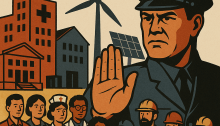
The End of Profit

Two forces are converging on the global economy. AI is driving the cost of cognition toward zero. Climate change is driving the cost of physical stability upward. Together, they dissolve the foundations of the market economy we inherited. In the emerging economy, what matters is access to resources and the capacity to manage risk.

When Growth Becomes a Cancer

Half of us will hear these words at some point in our lives. Cancer has become the defining disease of our age… But we rarely ask why this particular pathology, unlimited cellular growth, has become our era’s signature affliction. The answer may lie in recognizing that we have organized our civilization around a similar principle: growth without limits has become our highest aspiration and our deepest pathology.

'We Can't Afford It'

‘We Can’t Afford It’ Is a Political Choice

The Politics of “How Will We Pay For It?” In the polarized world of politics, a curious scene unfolds with metronomic regularity: a liberal policy proposal is made like universal healthcare, climate infrastructure or education expansion, only to be swiftly challenged by a familiar chorus: “How will we pay for it?” The question lands with…

The Church of the Invisible Hand

The Church of the Invisible Hand invites you to witness economics as our modern religion. Its priests in Brooks Brothers suits preach market efficiency, while its deity, the Invisible Hand, demands sacrifice from the many and blesses the few. Like all successful faiths, it presents itself as truth rather than contested ideology.

Congratulations! You’re Already a Millionaire

Your share of the nation’s water system is worth over $100,000, while that designer watch costs just $10,000. Which will still have value in fifty years? Your luxury car depreciates instantly, but your stake in national parks appreciates annually. The wealthiest investors can’t match the returns your citizenship already provides.

Humanity’s Achilles’ Heel

The rise of AI poses existential challenges to democracy, as algorithms increasingly shape governance and public discourse. The Cambridge Analytica scandal which brought us Brexit and the 2016 US election exemplifies this threat. To adapt, democracy must innovate through citizen assemblies and ethical frameworks, treating data as a collective resource and fostering pluralistic governance to navigate the complexities of the AI age effectively.

The Emperor’s New Economics

Shortly before he passed away in 1989, John Hicks, a revered economist, reflected on the simplified model he had introduced in 1937 to interpret John Maynard Keynes’ magnum opus ‘General Theory’ which had been published the year before. Using a plain pair of intersecting curves, Hicks had distilled Keynes’s complex ideas into equations that gained…

A Short History Of Human Coordination Failure

The history of human society is shaped by the history of human coordination. Over time, successful societies have evolved beyond the biological limits of unassisted human coordination (the Dunbar number of 150 people) which has necessitated the invention of collaboration technology to coordinate, control and coerce competing communities. It might be possible to map, as…

Book Review – Who Owns The Future? by Jaron Lanier

This book is a sobering account of the systematic destruction of value caused by the networked economy under whose spell we have fallen so deeply. It is a powerfully argued, complex and, at times, over-elaborate description of how we first invented and then released a genie that is disrupting its way through the fabric of…